It is 2 a.m. Your four-year-old is running a fever of 102.4. You think your partner gave him Tylenol around 11, but you were half asleep and you are not totally sure of the time. The next dose decision is sitting in front of you and you cannot afford to guess wrong.
This is the moment almost every parent has had. You can find a dosing chart on a hundred pediatric clinic websites. What you cannot find, anywhere, is a real answer to the question that actually matters at 2 a.m.: what was given, when, and by whom.
This article is about that second question. PillCaddy is a medication tracking app, not a source of medical advice. Anything about which medication to give, how much to give, or whether to alternate medications belongs to your pediatrician or pharmacist. What we can help with is the tracking layer that sits underneath those decisions, and that is what the rest of this guide is about.
Why tracking children's fever medicine is harder than it looks
On paper, this should be simple. Two common medications, a clear interval, a thermometer. In practice, it falls apart for reasons that have nothing to do with anyone being careless.
Two medications, two different intervals. Acetaminophen (Children's Tylenol) and ibuprofen (Children's Motrin or Advil) are dosed on different schedules. If your pediatrician has recommended both, you are tracking two clocks at once, not one. Even with a single medication, dosing intervals are wide enough (every four to six hours, or every six to eight hours, depending on the medication) that the next-dose time is rarely a round number.
Weight-based dosing. Children's medications are dosed by weight, which means the correct dose is a specific number of milliliters that does not stay the same from year to year as your child grows. It is not the kind of number you keep in your head. You look it up every time, or you should be.
Multiple caregivers. During the day it might be you and a partner. At night it might be both parents passing the baton in two-hour shifts. Sometimes it is a grandparent helping, a babysitter, or an older sibling pressed into service. Each person needs the same information, and that information lives in someone else's memory.
Sleep deprivation. Fevers do not respect bedtime. By the third dose of the night, you are not at your best. This is exactly when memory becomes the least reliable tool you could possibly be using.
Real safety stakes. A study funded by the National Institutes of Health found that more than 80 percent of parents made at least one dosing error when giving liquid medications, and the majority of those errors were overdoses. Acetaminophen in particular has a hard daily ceiling tied to liver safety. Going over that ceiling matters. So does missing the next dose entirely because nobody is sure what happened.
The takeaway is not that parents are bad at this. The takeaway is that the system most parents use, memory plus a vague sense of time, is not designed for the conditions in which it is being asked to work.
The coordination problem
Here is the scenario that catches most families off guard. You give your daughter Tylenol at 8 p.m. before bed. At midnight, she wakes up still hot. Your partner gets up to handle it because you are wiped out. Your partner does not want to wake you, so they do not ask. They check the medicine bottle, they check the clock, they do the best they can with the information they have. They give the next dose.
But what time was the first dose, exactly? You said "around 8." Was it 7:45 or 8:15? You do not remember. Your partner does not know. And the difference matters, because the next dose after this one is supposed to be calculated from the dose your partner is about to give.
Now multiply this across a 36-hour fever and three caregivers. You, your partner, and your mother-in-law who came over to help during the workday. The information gets fuzzier every time it changes hands. The chances of either skipping a dose by accident or doubling one go up.
The problem here is not memory. It is shared information. Two people who are both doing their best cannot coordinate around something that lives only in one person's head, in a state of half-sleep, twelve hours ago. The fix is not to remember harder. The fix is to write things down somewhere both people can see.
This is the same problem caregivers face when coordinating medications for an aging parent, or when two people share responsibility for a pet's medication schedule. The specifics change. The structure does not.
What to track for each dose
When parents say they are "keeping track," they usually mean they are trying to remember. That is not the same thing. A real log captures five pieces of information for every dose:
The medication name. Tylenol and acetaminophen are the same thing. Motrin, Advil, and ibuprofen are the same thing. In the middle of the night, brand names and generic names can blur together. Write down whichever appears on the bottle you actually used.
The dose. In milliliters for liquid medications, or in milligrams for tablets. Round numbers like "a teaspoon" or "the usual amount" are not specific enough to be useful later. If you ever needed to call Poison Control or your pediatrician, the exact amount is the first thing they will ask for.
The time. Not "around 11." 11:07. The next-dose math depends on this number. If you are using a phone-based log, the time is captured automatically, which is one of the strongest reasons to use one.
Who gave it. This sounds optional. It is not. When two parents are alternating, knowing who gave the last dose makes it easy to confirm with that person if anything is unclear. It also makes the schedule easier to hand off cleanly.
The child's temperature. Not strictly required, but useful. Tracking how the fever responds over time gives your pediatrician something to work with at the next call or visit, and it helps you make better decisions about whether the medication is doing what you hoped it would.
A log with these five fields takes about ten seconds to fill out. A log without them is not really a log.
Three ways to track (with honest tradeoffs)
There is no single right way to do this. There are a few common approaches, and each one has a clear failure mode.
The paper option. A sheet of paper on the kitchen counter, or a notebook by the bedside table. It is fast, it requires no setup, and you can hand it to anyone. The failure mode is obvious: it only works if everyone is physically near it. The second parent who is doing the midnight dose in a different room is not going to walk to the kitchen to check the log first. They will guess. Paper is fine for one caregiver in one place. It falls apart when the household spreads out.
The notes app on one phone. Open the Notes app on your phone, jot down each dose. Searchable, fast, and the timestamps come for free. The failure mode is also obvious: if the dose is being given by the other parent, the log is on the wrong phone. You can text each other every time, but the friction of that on a sick night is exactly enough that people stop doing it after the second dose. The log goes silent and the system has failed.
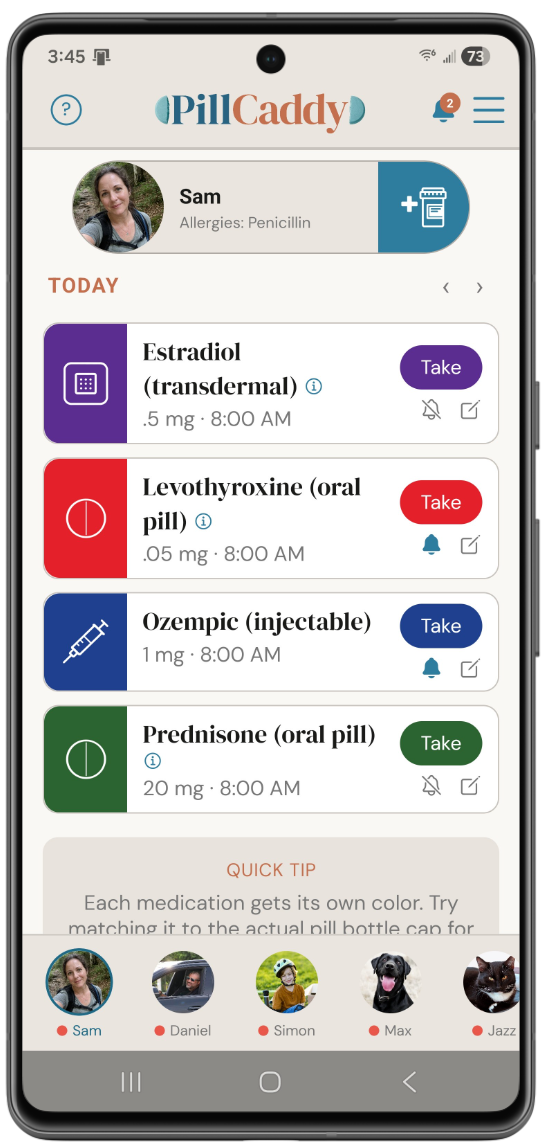
A shared app. A medication tracking app installed on both parents' phones, with the same household and the same child set up on both sides. When one parent logs a dose, the other parent sees it instantly. No texting, no asking, no walking to the kitchen. This is the only one of the three options that actually solves the coordination problem on a sick night, because it removes the requirement that two adults be in the same place at the same time to share information.
This is what PillCaddy is built for. If you are evaluating options, our roundup of the best medication reminder apps in 2026 goes into more detail on what to look for and which apps handle shared household use well.
Alternating Tylenol and ibuprofen safely
Pediatricians sometimes recommend alternating between acetaminophen and ibuprofen for a child with a persistent fever. Whether that approach is right for your child, and at what intervals, is a conversation between you and your pediatrician or pharmacist. This guide is not the place to get that information, and any article that gives you specific intervals without knowing your child's age, weight, and medical history is not being responsible with the topic.
What we can talk about is the tracking implication, because alternating doubles the complexity of the system that has to keep everything straight.
When you alternate, you are not running one schedule. You are running two interleaved schedules with different intervals. Each medication has its own next-dose time, its own daily maximum, and its own dosing math. The risk of error goes up not because the medications are more dangerous individually, but because there are now two parallel clocks running, often through the night, often across two caregivers.
A phone alarm does not solve this. An alarm fires at a fixed time whether or not the dose was already given by the other parent twenty minutes earlier. Alarms are a reminder system, not a record system. They cannot tell you what already happened.
A shared log can. When every dose is recorded the moment it is given, anyone looking at the log can see at a glance which medication was last given, when, by whom, and what the next-dose window is for each one. The schedule may be complicated. The information about the schedule does not have to be.
If your pediatrician has recommended alternating for your child, set up your tracking system before the next fever episode rather than during one. The middle of a hard night is the worst possible time to be configuring an app.
What to do if you think you double-dosed
Do not try to figure this out on your own. Call your pediatrician right away, or call Poison Control at 1-800-222-1222. Both lines are staffed around the clock. They will not be annoyed that you called. This is exactly what those numbers exist for.
When you call, they will ask you for specific information:
- Your child's age and weight
- The name of the medication and its concentration (look at the bottle)
- How much was given, and when, for each dose in question
- Any symptoms your child is currently showing
If you have been tracking doses, this information is already in one place and you can read it directly to them. If you have not been tracking, you may be trying to reconstruct the last several hours from memory under stress, which is part of how the situation became scary in the first place.
This is the case for a log even when nothing has gone wrong. The point is not paranoia. The point is that the cost of keeping the log is small, and the value of having it the one time you need it is very large.
Building a system before the next fever
This article so far has been about what to do during a fever. The more useful framing is what to do before one.
Children get sick. If they are in daycare or school, they get sick a lot, and most of those illnesses come with at least one feverish night. The first three or four years of parenthood are essentially a long series of these episodes. Setting up a tracking system once, in advance, when nobody is sick and nobody is exhausted, pays off every time it gets used.
A few practical steps:
Agree with your partner on the system. Both of you need to know how the log works and where it lives. If one of you has the app installed and the other does not, the system only works half the time.
Write down your child's current weight. This is what the dose is calculated from. Update it after pediatrician visits.
Confirm the correct doses with your pediatrician or pharmacist. Get the milliliters for your specific child, for each medication you keep on hand, written down somewhere you can find it at 2 a.m. without scrolling through clinic PDFs on your phone.
Keep the medications and the dosing syringes together. A measuring cup or a kitchen spoon is not accurate enough. Use the syringe that came with the medication.
Put the Poison Control number somewhere visible. 1-800-222-1222. Save it as a contact in both parents' phones.
The work to set this up takes about twenty minutes on a calm afternoon. It will save you hours of guesswork and stress across the next dozen fever nights.
Frequently asked questions
Can I give Tylenol and ibuprofen at the same time to my child? This is a question for your pediatrician or pharmacist, who can advise based on your child's age, weight, and medical history. Whatever they recommend, the tracking principle is the same: every dose of every medication goes in the log.
How long should I wait between Tylenol doses for my child? The standard dosing interval is listed on the medication packaging, but you should confirm the right interval for your child with your pediatrician. A shared tracking app will calculate the next-dose window automatically once you log each dose.
How long should I wait between ibuprofen doses for my child? The medication packaging includes a standard interval, but the right answer for your child is one your pediatrician should confirm based on age and weight. Tracking each dose makes the interval easy to monitor.
What is the safest way for two parents to track fever medicine? A shared tracking app that both parents have installed on their phones. When one parent logs a dose, the other parent sees it in real time, with no need to text, call, or remember to share. Paper logs and single-phone notes apps both break down the moment the second parent is the one giving the next dose.
What should I do if I think I gave my child too much Tylenol? Call Poison Control at 1-800-222-1222 or your pediatrician immediately. Have the medication bottle, your child's weight, and the times and amounts of recent doses ready when you call.
Should I wake my child up to give them fever medicine? That decision belongs to your pediatrician. If the question is coming up at 2 a.m. and you are unsure, call the after-hours pediatrician line. From a tracking perspective, if you do give a dose, log it the same way you would during the day.
Can I use a phone alarm to track my child's fever medicine? An alarm can remind you when a dose is due, but it cannot tell you whether a dose was already given by the other parent. For households with more than one caregiver, an alarm by itself is not enough. You also need a shared log that records what actually happened, not just what was scheduled.
What information should I write down each time I give my child medicine? Five things: the medication name, the dose, the time, who gave it, and your child's temperature at the time. These five fields are what your pediatrician or Poison Control will ask for if something needs to be reviewed later.
Tracking children's fever medicine is one of those parenting tasks that sounds simple until you are in the middle of it at 2 a.m. The dosing chart is not the hard part. The coordination is. Two parents, one sick kid, a long night, and a system that depends on memory is a system that will fail eventually.
PillCaddy is built for households like this. You can add your child as a member, log each dose in a few taps, and share access with everyone helping. When your partner gives the midnight dose, you see it instantly. When the morning dose comes around, the log is already there. No guessing, no texting, no walking to the kitchen to read a sheet of paper.
The same approach works for coordinating medications across the whole household, kids and adults and pets alike. One system, shared in real time, ready before the next fever shows up.

Ready to get organized?
PillCaddy is free to download. Start tracking your household medications in minutes.